

Goruli Mtsvane — A Unique Grape Variety of Kartli
G o r u l i M t s v a n e — A U n i q u e G r a p e V a r i e t y o f K a r t l i
Author: Levan Sepiskveradze | Originally published on Wine Club
Among Georgian white grape varieties, Goruli Mtsvane is one of the most renowned and distinctive. As the name suggests, this variety is primarily found in Kartli, especially in the Gori region, though it also appears in Racha, Meskheti, Imereti, and Kvemo Kartli. According to the “Ampelography of Georgia” (by M. Ramishvili, D. Tabidze, and N. Ketskhoveli), Goruli Mtsvane has had various local names in Kartli, including Tetri Potola, Jishiani Mtsvane, Lurji Mtsvane, Suramula, and others.
In western villages of Kartli (Borjomi and Khashuri regions) and Upper Imereti, the grape is also referred to as Kvishkhura. Ampelographers believe it spread to Imereti from the village of Kvishkheti in Borjomi. In small quantities, Goruli Mtsvane is also found in Racha, where it’s known as Tbiluri. The prominent Georgian historian and scholar Ivane Javakhishvili considered Goruli Mtsvane to be Kartli’s number one variety, capable of producing high-quality wine.
Goruli Mtsvane is often confused with Gorula, a completely different table grape variety. Unlike Goruli Mtsvane, Gorula is not used for winemaking, has higher sugar content, and produces larger clusters. However, years of experimentation by Georgian winemakers have shown that Gorula is not suitable for quality wine production.
Before the spread of phylloxera and fungal diseases, Goruli Mtsvane was widely planted in lowland vineyards on original (non-grafted) rootstock across central Kartli — including central and southern Gori, riverside villages in Kaspi, southern Mtskheta, and beyond — where the grape shows its best characteristics.
Goruli Mtsvane has traditionally been used to produce white table wine, but it has also been used differently. In some cases, it was blended (cuvéed) with Chinuri, another well-known Kartli grape, and the mix was fermented on Tavkveri pomace and skins. This produced a reddish wine known as Khidistavuri, a well-known Kartli specialty.
“Goruli Mtsvane is one of Kartli's leading endemic grape varieties. In the past, it was found across many regions of Georgia, and to some extent, still is. Not only Kartli cultivates this variety—Imereti and Racha growers have had success with it too. The grape accumulates significant sugar and is notable for its acidity. It's an excellent blending material for sparkling wines. Unfortunately, vineyard areas of Goruli Mtsvane in Georgia—especially in Kartli—are now quite limited. With more attention, it could greatly benefit Georgian viticulture and winemaking. Even at relatively high altitudes, Goruli Mtsvane accumulates enough sugar to produce high-quality wines. Past and present evidence shows it can thrive even in Meskheti."
Levan Ujmajuridze, Agronomist, Professor
Currently, only two major Georgian wine producers bottle wines made from Goruli Mtsvane:
Château Mukhrani, which makes a dry wine
Bagrationi 1882, a sparkling wine producer, which blends Goruli Mtsvane with Chinuri
Apart from Château Mukhrani, no large wine company produces a varietal wine exclusively from Goruli Mtsvane.
“Goruli Mtsvane is indigenous to the Kartli region and has been known for the past 700–900 years. It is the parent variety of Atenuri, and it also has potential for oak aging, a quality less expressed in other Georgian varieties. The grape has a unique palette of varietal tones and vibrant, lively taste qualities, well-suited for both modern and traditional Georgian winemaking techniques. This adaptability makes it a candidate for elite wines of the present and future. Our vineyards lie in the heart of the Mukhrani Valley. We currently produce two wines from this grape: Château Mukhrani Goruli Mtsvane — around 40,000 bottles/year, in the premium segment Château Mukhrani Réserve du Prince — 6,500 bottles/year, in the super-premium segment”
Lado Uzunashvili, Winemaker at Château Mukhrani
In Kakheti, a small artisanal winery called “Chveni Ghvino” (“Our Wine”) in the Gurjaani region also bottles Goruli Mtsvane. They use traditional Georgian methods: fermentation in qvevri (clay vessels), on skins and stems. While produced in small quantities for a niche market, even this Kakhetian version demonstrates the variety’s remarkable versatility, showing that it can yield excellent results outside Kartli.
Viticultural Traits
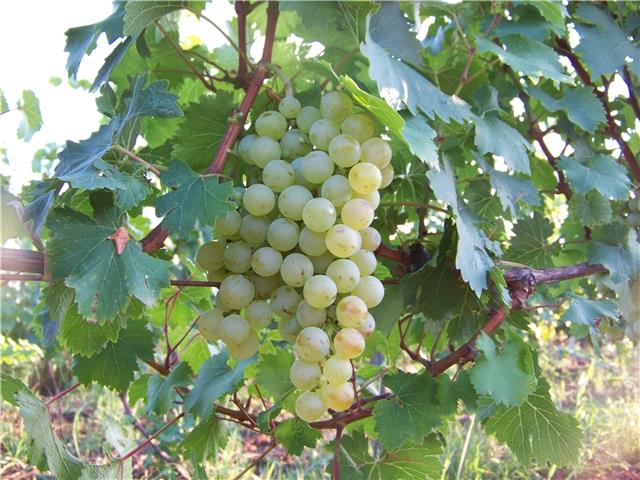
Goruli Mtsvane vines are moderately productive. Typically, each shoot bears one cluster, rarely two. According to Georgian ampelographers, average cluster weight ranges between 70–240 grams.
The grape plays a critical role in Georgian sparkling wine production, mainly as a blending base. A blend of Goruli Mtsvane and Chinuri results in higher acidity sparkling wine compared to wines made from either variety separately.
Goruli Mtsvane is not a table grape. Its thick, coarse skin and sourish flavor, along with poor storage longevity, make it unsuitable for fresh consumption. Among several known variations, one known as Mukhamtsvane stands out. According to ampelographer N. Chakhnashvili, this variation grows smaller clusters and berries, and is less vigorous, making it less promising.
“In our village of Khidistavi, Goruli Mtsvane thrives beautifully. Everyone agrees that our wine from this grape is among the best. The grape is productive and resistant to diseases. It has high acidity and high sugar content — among our local varieties, only Tavkveri can match its sweetness. Most years, Goruli Mtsvane accumulates more sugar than other Kartli grapes. Its wine has a leafy green color, giving it a unique identity. With proper vineyard care and winemaking, you get a fragrant, enjoyable wine. Goruli Mtsvane performs best in clay soils, though I’ve seen it grow well elsewhere too. I have an older vineyard that needs renewal, but I still produce at least 1.5 tons of wine yearly. I sell the rest of the grapes due to limited storage. If I had more vessels, I’d make more wine. I’m planning to expand next year.”
Gogi Dvalishvili, Winemaker and Viticulturist
During the Soviet era, and even earlier, Goruli Mtsvane was among Georgia’s top five varieties by volume. However, vineyard areas have since drastically declined—even in Kartli. This decline is linked to economic hardship and a general drop in Georgian wine quality, which reduced interest in native grape diversity.
According to ampelographers and wine experts, Goruli Mtsvane is a variety capable of producing exceptional and diverse wines, deserving special attention and revival.

Mikheil Tlashadze
The author is passionate about Georgia’s wine heritage, focusing on unique regions like the Ateni Specific Viticulture Area. Their work highlights the distinct character of Kartli’s terroir and traditions.